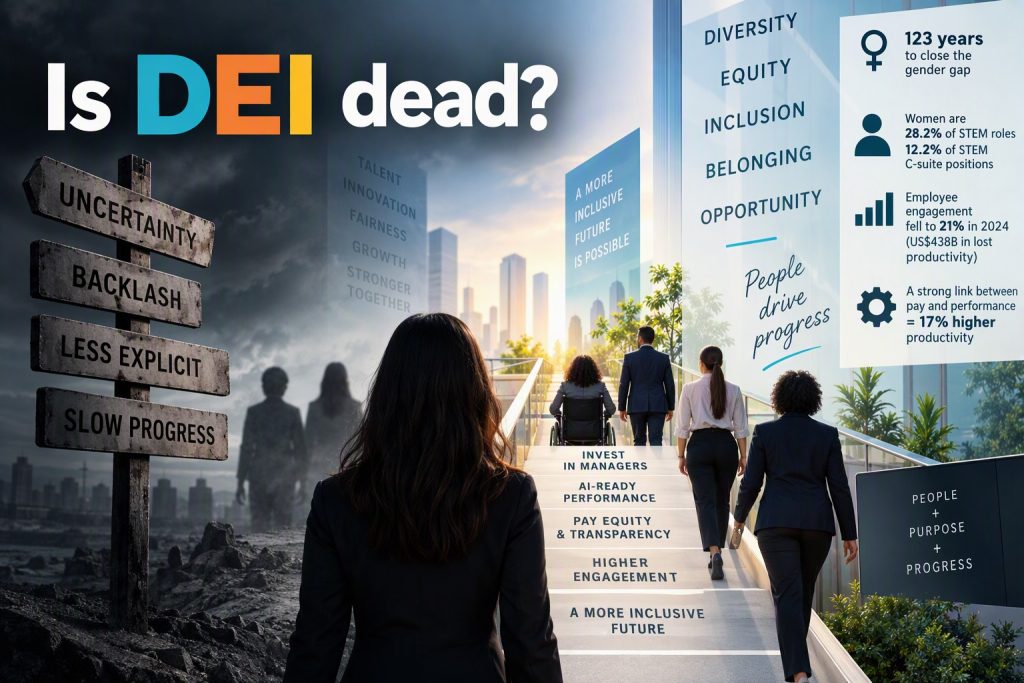
While few companies are abandoning DEI (diversity, equity, inclusion) efforts altogether, the overall effect has been to make DEI initiatives more cautious, less explicit and more internally focused.
“At the current pace, closing the global gender gap will take 123 years, roughly five generations, with disparities in workforce representation, pay, and leadership hindering economic growth,” warns the World Economic Forum. “The global economy can’t afford to leave talent on the sidelines.”
Has the rapid adoption of AI increased gender parity in the workplace? No. Quite the opposite. Women remain underrepresented across the AI ecosystem, accounting for only 28.2% of STEM (science, tech, engineering, math) roles and 12.2% of STEM C-suite positions, the WEF notes. Women are also disproportionately concentrated in roles vulnerable to automation.
Gallup’s State of the Global Workplace poll found that employee engagement fell to 21% globally in 2024, the lowest levels seen since Covid-19. That translated to US$438 billion in lost productivity. Female managers saw a seven-point fall, while overall manager well-being declined.
One solution? Invest in managers. People managers sit at the core of the employee experience. They drive culture, shape daily work environments, and serve as the bridge between strategic goals and human needs. “When managers are equipped, supported, and connected to purpose, they can unlock engagement and well-being across an organisation,” Gallup notes.
Another way to respond in the AI era? Evolve pay for performance. A Gartner survey found that when employees believe there is a strong link between pay and performance, they are 17% more productive. Gartner recommends redefining an AI-ready performance philosophy, applying AI with risk-informed guardrails while preserving pay equity, transparency and managers’ ability to explain outcomes.
LinkedIn: https://lnkd.in/p/gn3Nt7BR
Article: https://bit.ly/3VWRVBT